
Dining with a service animal in Maui requires preparation to ensure a smooth experience. Hawaii’s strict quarantine laws and restaurant policies mean you must understand regulations and etiquette before heading out. Here’s what you need to know:
- Service Animal Definition: Only dogs trained to perform tasks for disabilities qualify. Emotional support animals don’t count and are not allowed in restaurants.
- Legal Rights: Restaurants can only ask two questions: "Is the dog a service animal required because of a disability?" and "What work or task has the dog been trained to perform?" No certification or ID is needed.
- Hawaii Quarantine Rules: Obtain a Neighbor Island Inspection Permit (NIIP) at least 30 days in advance. Requirements include rabies vaccinations, microchip, and health certificates.
- Restaurant Etiquette: Keep your service animal leashed, on the floor, and under control. They cannot eat or drink from restaurant dishes. Disruptive behavior may lead to removal.
- Planning Ahead: Use resources like the Maui Oceanfront Dining Directory 2026 to find service animal-friendly restaurants. Call ahead to confirm policies and request suitable seating.
Preparation and following these guidelines will help ensure a stress-free dining experience for you and your service animal.
Preparation Steps Before Dining
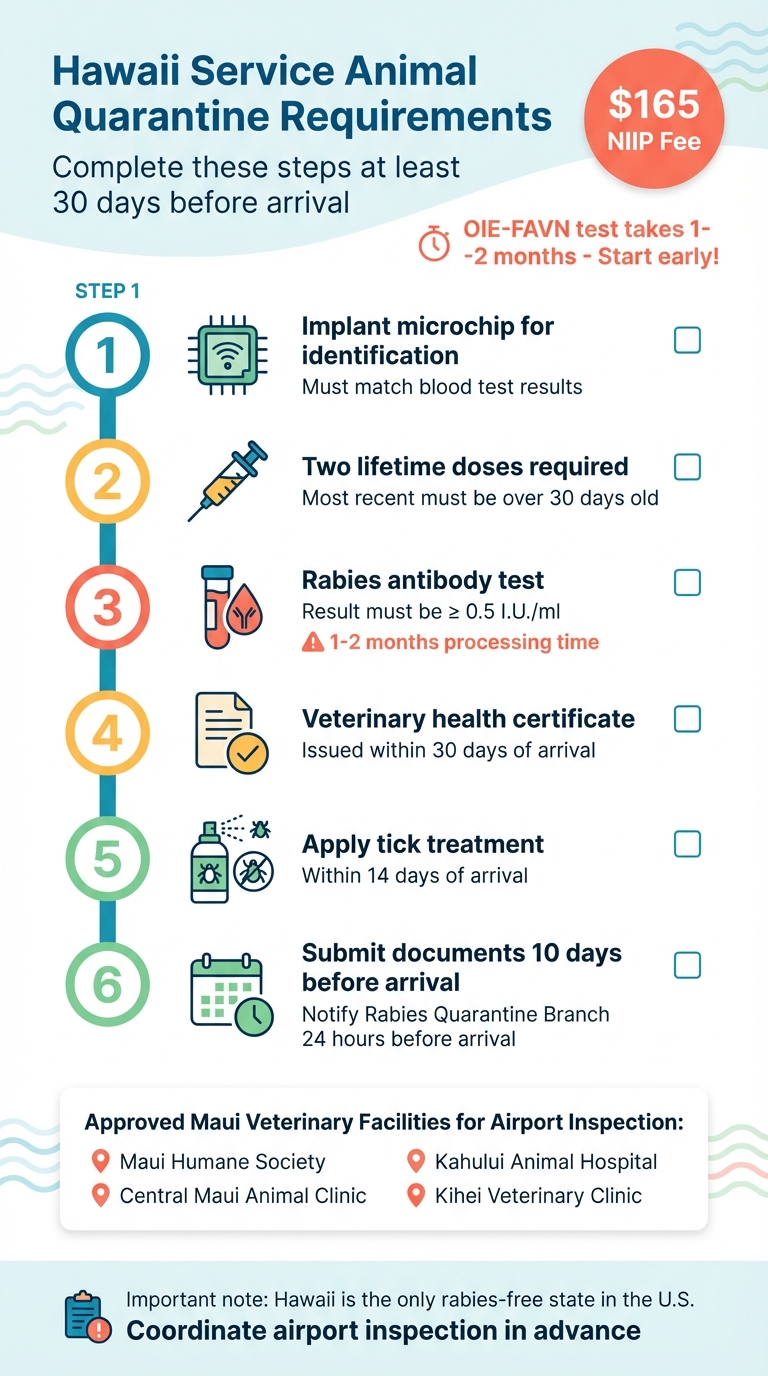
Hawaii Service Animal Quarantine Requirements Checklist
Know the Service Animal Laws
In Hawaii, a service animal is defined as a dog specifically trained to perform tasks for an individual with a physical, sensory, psychiatric, intellectual, or other mental disability. If you have a service animal, it’s allowed to accompany you in any area of a restaurant where the general public is permitted.
Restaurant staff cannot demand proof of certification, ID cards, or medical paperwork. Additionally, your service animal doesn’t need to wear a vest. However, it’s essential to ensure your service animal is housebroken and well-behaved. If the animal becomes disruptive or isn’t housebroken, the restaurant can ask you to remove it, though you’re still allowed to return and finish your meal.
It’s worth noting that misrepresenting a pet as a service animal is against Hawaii law as of January 1, 2019, and could result in civil penalties. While restaurants cannot charge a "pet fee", you are financially responsible for any damage your service animal causes to the property.
Understanding these guidelines will help you navigate Hawaii’s specific requirements for service animals.
Check Hawaii Animal Quarantine Rules
As the only rabies-free state in the U.S., Hawaii enforces strict quarantine measures. If you’re flying directly into Kahului Airport on Maui with your service animal, you’ll need a Neighbor Island Inspection Permit (NIIP). This permit costs $165 and must be obtained at least 30 days before your arrival. Additionally, you’ll need to coordinate with an approved veterinary facility on Maui for the mandatory airport inspection.
Here’s what you’ll need to prepare for your service animal:
| Requirement | Specification |
|---|---|
| Microchip | Must be implanted for identification and match the blood test results. |
| Rabies Vaccinations | Two lifetime doses required; the most recent must be over 30 days old. |
| OIE-FAVN Test | Blood test result must be ≥ 0.5 I.U./ml. |
| Health Certificate | Issued within 30 days of arrival. |
| Tick Treatment | Applied within 14 days of arrival. |
| Notification | Notify the Rabies Quarantine Branch 24 hours before arrival. |
The OIE-FAVN test can take one to two months, so start the process early. Submit all required documents – such as rabies certificates, blood test results, and import forms – to the Rabies Quarantine Branch at least 10 days before your arrival to avoid higher fees. For the airport inspection, you can choose from approved clinics like Maui Humane Society, Central Maui Animal Clinic, Kahului Animal Hospital, or Kihei Veterinary Clinic.
Once these steps are complete, you can focus on finding the right dining spot.
Identify Suitable Restaurants Using Maui Oceanfront Dining Directory 2026
To ensure a smooth dining experience, refer to the Maui Oceanfront Dining Directory 2026. This resource helps you locate restaurants that are both accessible and service animal-friendly. Use the directory’s search tools to find places with outdoor seating or quiet areas, which allow your service animal to rest comfortably under the table while minimizing potential distractions.
Before heading out, it’s a good idea to call the restaurant. Confirm that the staff is familiar with the "two questions" rule and won’t ask for unnecessary documentation like certification or ID cards, which are not legally required. Also, check if the restaurant has enough space to accommodate your service animal safely without obstructing walkways. The directory provides detailed information about each restaurant, including amenities, accessibility features, and hours of operation, making it easier to plan your visit and avoid unexpected challenges for you and your service animal.
sbb-itb-dfba65a
How to Choose a Service Animal-Friendly Restaurant
Look for Outdoor Seating and Accessibility
Outdoor patios and oceanfront decks are ideal when dining with a service animal. These spaces offer fresh air and plenty of room, making movement easier for both you and your companion. Restaurants listed as wheelchair accessible in the Maui Oceanfront Dining Directory 2026 often feature wider pathways and more spacious table arrangements, which naturally accommodate service animals as well.
"Guests often prefer quieter seating areas to minimize distractions." – Peter Bellisario, Food Safety Auditor
When reserving a table, ask for perimeter seating, such as a corner or wall-side spot. This setup gives your service animal a secure and comfortable place away from high-traffic areas like server walkways. Before committing to a venue, skim recent reviews to gauge the layout. If reviews mention "tight spaces" or "tables close together", it might not be the best choice for larger service animals. For instance, Mala Ocean Tavern, with its 4.8/5 rating from over 10,000 OpenTable reviews as of February 2026, is frequently praised for its spacious outdoor patio and oceanfront views.
Once you’ve identified a potential spot, it’s a good idea to confirm their service animal policies.
Verify Service Animal Policies in Advance
Even with the perfect seating environment, it’s essential to ensure the restaurant complies with service animal guidelines. Call ahead to confirm ADA compliance and inquire about seating accommodations. For example, you can reach Lahaina Fish Co. at 808-661-3472 or Mala Ocean Tavern at 808-667-9394 to clarify their policies. Staff should follow standard ADA protocols, meaning they won’t ask for certification, ID cards, or require your service animal to wear a vest.
The Maui Oceanfront Dining Directory 2026 is a helpful resource for this kind of planning. It includes detailed information about each restaurant’s amenities, accessibility features, and contact details, making it easier to confirm policies before you arrive. You can even filter for tags like "Outdoor Dining" or "Wheelchair Accessible" to find venues experienced in accommodating service animals. Additionally, ensure the restaurant understands the legal distinction between service animals and emotional support animals, as required by Hawaiʻi law. A little preparation goes a long way toward ensuring a smooth and enjoyable dining experience.
Service Animal Etiquette at Restaurants
When dining out with a service animal, following basic etiquette can make the experience smooth for everyone involved.
Keep Your Service Animal Under Control
Your service animal should always be under control, whether by leash, harness, or tether – unless these interfere with its tasks due to your disability. In such cases, control should be maintained through voice commands, hand signals, or other methods.
"The animal must also be under the handler’s control at all time and usually that means on a leash or harness." – Hawaii Restaurant Association
Place your service animal beside your chair, keeping it on the floor and away from furniture and walkways. This ensures servers can move safely and other guests aren’t inconvenienced. If your animal becomes restless or starts barking, step outside briefly or use commands to refocus them.
Maintaining cleanliness is another important aspect of dining with a service animal.
Maintain Cleanliness Standards
Before heading to a restaurant, make sure your service animal is housebroken. If an accident happens, the restaurant has the right to request the animal’s removal, but you are still entitled to finish your meal. To avoid issues, use a designated relief area before entering.
Service animals should not eat or drink from restaurant dishes, as this violates food safety guidelines like the Hawaii Food Safety Code. Instead, bring a collapsible bowl for water and use it outside the dining area. Feeding your service animal at the table can also distract them from their duties, so it’s best avoided.
To further minimize disruptions, choose a seating arrangement that works best for you and your service animal.
Reduce Potential Disruptions
Opt for a quieter table away from busy areas to give your service animal enough space to lie down and stay calm. This also helps reduce distractions caused by passing staff or diners.
"In my experience, guests with Service animals generally wish to sit in a quieter area where there are less people walking by. Also, staff or other guests should not pet or play with the animal – they are on duty!!" – Peter Bellisario, PeterBFoodSafetyAudits.com
Politely inform staff and nearby diners that your service animal is working and should not be petted or fed. If another guest has severe allergies, the restaurant may offer to move them, but you cannot be asked to relocate or sit in isolation. Keep an eye on your service animal throughout the meal, and if the environment becomes too stimulating, you can request a table change or step outside briefly to help them settle.
Addressing Common Issues
Even with careful planning, challenges can sometimes arise when dining with your service animal. Knowing how to handle these situations can help you protect your rights while ensuring a smooth experience.
Managing Disruptive Behavior
If your service animal exhibits disruptive behaviors – like constant barking, aggression, or accidents – the restaurant has the right to ask you to remove the animal. To address this, step outside briefly to refocus your animal or move to a quiet spot away from other diners. If the behavior continues and removal becomes necessary, you are still allowed to finish your meal without your service animal present.
Next, let’s tackle misunderstandings about your service animal’s role.
Explaining Service Animal vs. Pet Differences
It’s not uncommon for restaurant staff to question whether your animal is a legitimate service animal, especially if your disability isn’t immediately visible. According to federal ADA law and Hawaii state law, staff can only ask two questions: Is the dog a service animal required because of a disability? and What work or task has the dog been trained to perform?. A straightforward response like, "Yes, she alerts me to seizures", or "He retrieves dropped items", is sufficient. Importantly, staff cannot request documentation, certification, or a demonstration of your dog’s tasks.
"Emotional, companionship or comfort support animals are NOT considered as Service Animals, and are NOT allowed into your facility." – Hawaii Restaurant Association
If confusion lingers, you can emphasize that only trained service animals are legally permitted in dining establishments.
Understanding Your Legal Rights
If you face denial of entry, calmly ask to speak with a manager and explain that allergies, fear, or breed concerns are not valid reasons to exclude your service animal. Document any unlawful denial for further action, which could involve filing a complaint with the U.S. Department of Justice or pursuing a private lawsuit in federal court. Keep in mind that while Hawaii law holds you responsible for any damage your service animal causes, restaurants cannot charge extra fees or require you to sit in a separate area.
Conclusion
Dining with your service animal in Maui takes some planning, but it’s manageable with the right steps. First, make sure your service animal complies with Hawaii’s strict quarantine rules. This includes completing the OIE-FAVN rabies antibody test and notifying the Rabies Quarantine Branch at least 24 hours before your arrival to avoid any quarantine issues. Once that’s sorted, focus on finding a restaurant that accommodates both you and your service animal.
The Maui Oceanfront Dining Directory 2026 can be a helpful resource, showcasing restaurants with outdoor seating, wheelchair access, and pet-friendly policies. Spots like Mala Ocean Tavern and Castaway Cafe are known for welcoming service animals and providing the necessary space and amenities for handlers. It’s always a good idea to call ahead to confirm their policies and, if needed, request a quieter seating area.
While dining, keep your service animal leashed or harnessed and ensure it stays on the floor at all times.
FAQs
How early should I start Maui quarantine paperwork for my service dog?
Start preparing your Maui quarantine paperwork at least 120 days before your trip. This timeline gives you enough room to complete all the necessary steps, such as ensuring your pet has up-to-date rabies vaccinations, a microchip, and the required blood tests.
What should I say if a restaurant asks for my service dog’s ID or papers?
Under the Americans with Disabilities Act (ADA), restaurants cannot demand identification or documentation for your service dog. They are limited to asking just two questions: Is the dog a service animal required because of a disability? and What specific task or work is the dog trained to perform?
What’s the best way to handle allergies or complaints from nearby diners?
To handle allergies or complaints, make sure the service animal remains on the floor and refrains from eating or drinking in the restaurant. If the animal acts disruptively – such as barking or growling – kindly request that the handler take control of the situation. The goal is to create a respectful and welcoming atmosphere for all guests.
Related Blog Posts
- Where to Find Family-Friendly Beachfront Dining in Maui
- Complete Checklist for Booking Maui Beachside Dining
- Ultimate Guide to Maui Ocean View Dining in 2026
- Checklist for Perfect Sunset Seafood Dining in Maui
